
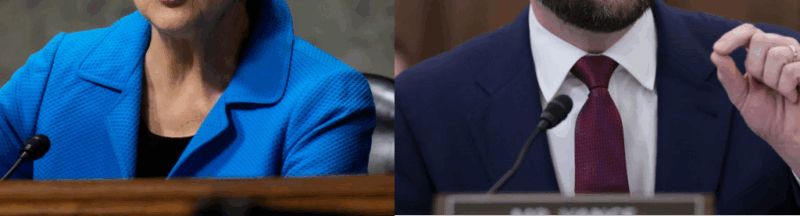
Vance Responds To Senator
The political fallout from President Donald Trump’s historic Israel-Hamas peace deal continues to reverberate—and nowhere is the discomfort more visible than in the strained, awkward, and sometimes laughable reactions from prominent Democrats.
To be fair, a handful of voices on the left managed to respond with the grace the moment called for, acknowledging the extraordinary breakthrough in ending the two-year hostage crisis. But for many others, the temptation to either downplay Trump’s role or insert themselves into the narrative proved too strong to resist.
For two excruciating years, I have called for the return of the hostages brutally kidnapped on October 7th and held in Gaza.
Today is a good day. Surviving Israeli hostages are finally home and reuniting with loved ones. I'm thinking of them and their families on this joyful day… https://t.co/V6uDL89Gzj
— Elizabeth Warren (@SenWarren) October 13, 2025
The most glaring example came from former President Barack Obama, who issued a carefully worded statement praising the deal without ever mentioning Trump by name. Even CNN’s Kaitlan Collins, no stranger to navigating D.C. etiquette, pointed out the pettiness of that omission. It was an act of omission that revealed far more than it concealed: the inability of some Democrats to acknowledge political success when it comes from outside their tribe.
But Obama wasn’t alone. Senator Elizabeth Warren took to social media to commemorate the hostages’ return, delivering a statement drenched in performative empathy and vague platitudes—while subtly implying that her two years of "calling for" their release had somehow contributed to the outcome. As if Hamas negotiators were holding out for a tweet from Massachusetts.
How on earth do you post this note without uttering the words “Donald J. Trump”??
Partisanship blindness and hatred are tearing us apart. https://t.co/pvyUKVv7H7
— Ted Cruz (@tedcruz) October 13, 2025
Warren’s tone-deaf messaging quickly turned into political farce. Senator Ted Cruz offered a pointed correction: “What she should have said was, ‘Thank you, President Trump.’” And Vice President JD Vance delivered the finishing blow, mocking Warren’s infamous Native American ancestry debacle by quipping, “The president told me he did this on Indigenous Peoples Day in honor of you.”
It was a masterclass in political trolling—and one that hit its mark.
What’s so telling is the contrast in approach. Democrats like Warren often traffic in symbolism, statements, and hashtags—acts of political theater designed to signal concern without producing results. Trump, for all his bombast, actually brokered a deal and got the hostages home. That’s not a tweet. That’s not a Senate floor speech. That’s history.
Funny enough, Elizabeth Warren’s 1/1024th Native American ancestry is still a larger percentage than her contribution to rescuing hostages or achieving a Middle East peace deal. https://t.co/c5EQCcAuZ8
— Steve Guest (@SteveGuest) October 13, 2025
And let’s not forget the backdrop here: while the Trump administration worked quietly to bring Hamas to the table, many on the American left were fueling chaos with loud pro-Hamas protests and relentless anti-Israel agitation. Whether they realized it or not, their public pressure likely emboldened Hamas to stall negotiations. In that sense, much of the progressive base didn’t just fail to help the peace process—they arguably made it harder.
The president told me he did this on Indigenous Peoples Day in honor of you. https://t.co/KsTPzHQ2yz
— JD Vance (@JDVance) October 13, 2025
But now that peace has arrived—however fragile—Democrats are scrambling to frame themselves as part of the solution. The problem is, the facts don’t cooperate. When the deal was sealed, it wasn’t Liz Warren or Barack Obama or Bernie Sanders on the phone with Middle Eastern leaders. It was Donald Trump. And it was Marco Rubio. And it was the people who still believe America can be a force for peace through strength, not hashtags.