
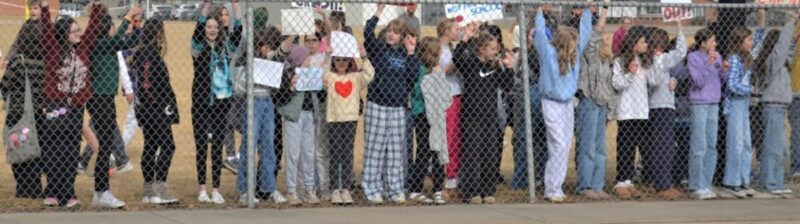
School Instruction Sparks Debate
If the goal of public education is to prepare students for civic life, Jefferson County, Colorado may have just demonstrated how far that mission has drifted from anything recognizable as neutral instruction. According to multiple reports, a presentation was delivered inside a public school that did not merely discuss immigration policy or constitutional theory, but actively instructed students on how to document and track federal immigration officers during enforcement operations.
The presentation reportedly trained students on the acronym “S.A.L.U.T.E.,” a method commonly used in military and intelligence contexts to gather detailed information about personnel and operations. Students were told to note the number of officers, their appearance, their equipment, and their precise location. One slide reportedly instructed them to “document and record everything,” framing the activity as a civic duty rather than what it plainly resembles: surveillance of federal law enforcement by minors.
OMG. Students at @JeffcoSchoolsCo were reportedly subjected to an anti-ICE presentation that demonized ICE and taught children how to report and dox federal agents.
This is completely unacceptable. Every staff member responsible for this needs to be FIRED. pic.twitter.com/jG4GfE2uvq
— Libs of TikTok (@libsoftiktok) February 3, 2026
Even more troubling was the ideological framing layered on top of this instruction. Students were allegedly told that “ICE leadership has given officers the go-ahead to violate the Constitution,” a sweeping claim presented not as an allegation to be debated, but as settled fact. There is a profound difference between teaching students how constitutional questions are litigated and telling them, outright, that federal agents are operating unlawfully as a matter of course.
The presentation went further still, directing students to links for so-called “ICE Trainings” and Signal group chats, tools that mirror those used by organized activist networks in cities like Minneapolis. Those networks have been used to track, surround, and interfere with ICE officers conducting lawful operations. In some cases, similar trainings circulating online have included guidance on pressuring officers and escalating confrontations to disrupt arrests. Whether or not that specific content was included in the classroom presentation, the pathway being laid out is unmistakable.
Fliers were reportedly posted in school hallways to spread the information to students who may not have attended the presentation, suggesting this was not a one-off discussion but an organized effort to recruit participation. At that point, the line between education and activism disappears entirely.
Look at the training “MN Ice Watch” (which Renee Good belonged to) gives:
They train activists to assault law enforcement, to swarm, pressure, and open their car doors.
And they say each “de-arrest” is a “micro-intifada.” Do with that what you will.
H/t @StrackHaley pic.twitter.com/5TjXzJfljy
— Matt Whitlock (@MattWhitlock) January 11, 2026
This is not an isolated phenomenon. Just days ago, CNN ran a sympathetic profile of two high school-aged brothers in Minneapolis who work as “ICE watchers” alongside their parents, portraying the activity as youthful civic engagement rather than as minors inserting themselves into volatile law enforcement situations. The pattern is becoming clear: adults with strong political agendas are increasingly comfortable pulling children into confrontational, and potentially dangerous, forms of activism.
The consequences of this approach are not theoretical. Teaching students to monitor federal agents, join encrypted group chats, and assume bad faith by default escalates tension and invites conflict. It also places children in situations they are neither trained nor legally authorized to handle. Public schools are not activist training camps, and students are not foot soldiers in an ideological struggle.