

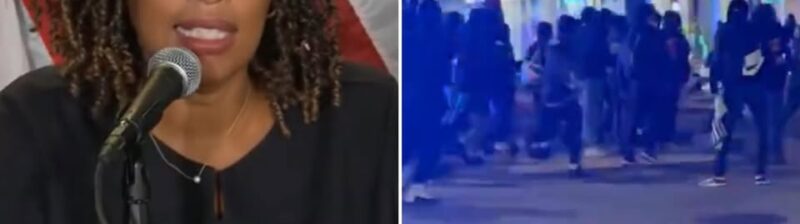
DC Mayor Enacts Curfew Following Video
In a city already wrestling with rising crime and eroding public trust, Washington D.C. Mayor Muriel Bowser has taken an extraordinary step: enacting a targeted juvenile curfew across high-risk areas of the District following a surge of violent youth-related incidents. From Nov. 1 through Nov. 5, under the authority of Mayor’s Order 2025-115, Special Juvenile Curfew Zones have been established in response to large-scale brawls, vandalism, and assaults committed by roving groups of teenagers.
This is not a hypothetical problem. On Oct. 13, more than 100 minors reportedly rampaged from Navy Yard to Union Station and even as far as Shady Grove. In under 10 minutes, they vandalized property, assaulted a theater employee, and stole merchandise. Less than a week later, another mass fight erupted across multiple D.C. neighborhoods. On Halloween night, yet another melee was captured on video, drawing renewed scrutiny from city officials and concern from residents already on edge.
We are declaring a limited juvenile curfew in Washington, DC.
Effective immediately, all juveniles under the age of 18 are subject to a curfew from 11PM until 6AM, which will extend through 11/5.
This is in response to several weeks of disorderly juvenile behavior which…
— Mayor Muriel Bowser (@MayorBowser) November 1, 2025
The new order requires anyone under 18 to clear out of public spaces in designated areas by 11:00 p.m., unless they’re participating in exempted activities like work, school, or accompanied by a parent. But in the specially designated zones — including the U Street Corridor, Navy Yard, Union Station, and Banneker Recreation Center — the restrictions begin even earlier, from 6:00 p.m. to 11:00 p.m. over the weekend.
The urgency stems from what happened when an earlier juvenile curfew bill expired on October 5. In just a few short weeks, the District saw a dramatic spike in youth-led violence, prompting both Bowser and D.C. Police Chief Pamela A. Smith to take decisive action. These new curfew zones allow police to detain and remove unsupervised minors from targeted public spaces, not as a punitive measure, but as a practical tool to prevent chaos.
In principle, curfews are controversial — raising questions about civil liberties, enforcement equity, and long-term impact. But the decision here appears to be grounded in data and driven by real-time events. When over 100 teens can vandalize property, assault workers, and terrorize bystanders in broad daylight — often coordinated via social media — public officials are left with limited options.
Pursuant to Mayor's Order 2025-115, Special Juvenile Curfew Zones will go into effect this evening around the following locations:
▶️U Street Corridor
▶️Banneker Recreation Center
▶️Navy Yard
▶️Union Station— DC Police Department (@DCPoliceDept) November 1, 2025
It’s also important to note that the restrictions aren’t blanket laws across the entire city. They’re strategic and temporary, aimed at preventing further escalation in very specific neighborhoods with recent, documented issues. The Navy Yard perimeter, for example, has been carefully defined from I-695 to the Anacostia River, and from South Capitol Street to 8th Street, SE — a recognition that this isn’t a citywide overreach, but a focused response to localized disorder.
Still, there’s an undeniable undertone to all of this: Washington’s struggle to maintain order amid a shifting cultural and political landscape. Juvenile crime isn’t new, but the sheer scale and speed of these incidents — and the seeming inability of traditional deterrents to curb them — speaks to a deeper fracture.
CHAOS IN DC: Youth Mob Attacks National Guard.
Kids are out there brawling with soldiers — lock them up before this turns into the new normal.
SMH - where are the parents? pic.twitter.com/gYOygZwqTq
— Kristin Sokoloff (@ksoklower48) November 1, 2025
The mayor’s decision may be unpopular in some circles, but the scenes leading up to it left little choice. The balance between civil liberty and public safety is never easy to strike, but when public spaces become flashpoints for organized violence, that balance demands clarity and courage.