
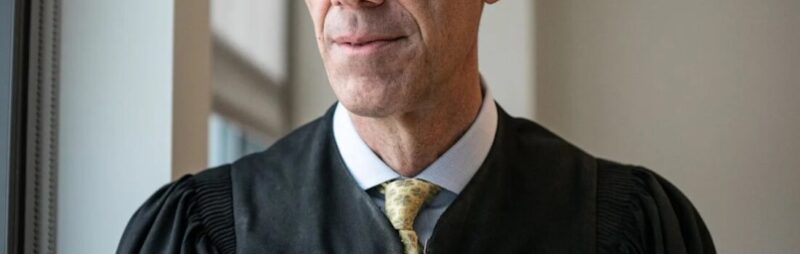
Judge Grants Bail In High Profile Case
There are bad judges. And then there are judges who trade the robe of impartiality for the crown of tyranny — and Chief U.S. District Judge James Boasberg is, by every indication, the latter.
When I practiced law, there were judges who were simply difficult — strict, quirky, even egotistical. But then there were those who held personal grudges, weaponized their authority, and ruled not with justice in mind, but with an axe to grind. Those are the judges you avoid, or “paper” if you're lucky enough to practice in a jurisdiction that allows it. They don't belong on the bench. And yet, in Washington, D.C., they thrive.
Judge Boasberg has shown, time and again, that he is not merely biased — he is actively hostile toward Donald Trump, his supporters, and the political right at large. This isn’t hyperbole. This is observable, documented behavior.
He denied bail to non-violent January 6 defendants, including the infamous "QAnon Shaman," Jacob Chansley — a man whose greatest crime, according to the court, was symbolism. The image of Chansley — shirtless, painted, horned hat perched atop his head — became a meme. A caricature. And for that, he was deemed a public threat and held in solitary confinement. Not because of what he did, but because of what he represented.
Contrast that with Boasberg’s recent handling of Nathalie Rose Jones, a woman who explicitly threatened to assassinate the sitting President of the United States. She didn’t joke, didn’t hint. She wrote that she would “disembowel” Trump and “cut out his trachea” — then confirmed those threats to Secret Service agents. The case was clear. A magistrate judge ordered her held. Boasberg, in his wisdom, let her go — under electronic monitoring and with a gentle suggestion to see a psychiatrist.
“Why shouldn’t we consider this the rantings of someone with a mental illness with no ability to carry this out?” Boasberg asked.
That’s not judicial reasoning. That’s rationalizing. Because when a person threatens to assassinate the president — a federal felony — the court is not tasked with diagnosing her mental health. It's tasked with protecting the public and upholding the rule of law. You don’t need to “have a gun” in hand for a death threat to be a crime. If a J6 defendant in a Viking hat is enough to justify solitary confinement, how is an open death threat not enough to warrant pre-trial detention?
This is not just a case of inconsistent rulings. It’s a pattern of ideological imbalance so blatant it threatens the foundation of impartial justice. Boasberg has, according to multiple sources, invoked Kafka to justify his decisions, spoken publicly in favor of harsher penalties for even non-violent J6 defendants, and now, excuses actual threats of violence as harmless delusion.
It’s no longer just about Trump. It’s about the law being applied unevenly — one standard for political enemies, another for ideological allies or those seen as non-threatening to the prevailing narrative in D.C.
We are not talking about fringe cases. We are talking about the federal judiciary. And when federal judges start playing politics from the bench, they stop being judges. They become enforcers. The selective leniency for someone like Jones, compared with the hammer dropped on J6 defendants, reveals a system not just broken — but compromised.