
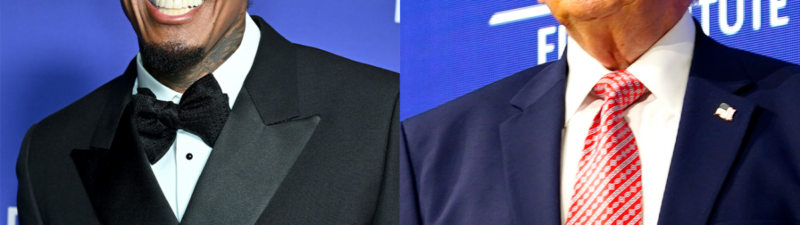
Popular TV Host Puts Democratic Party On Blast
Nick Cannon set off a sharp reaction after remarks on his Tubi show Big Drive pulled him directly into a politically charged debate over party history and modern alignment.
During a conversation with model Amber Rose, Cannon agreed with her claim that Democrats fail to support people of color while Republicans do. He went further, referencing long-debated historical points about party origins, stating that Democrats were once associated with the Ku Klux Klan and that Republicans played a central role in ending slavery. He framed his own position as politically detached, invoking W.E.B. Du Bois’ critique that party divisions can mask deeper similarities in power structures.
The discussion didn’t stop at history. Cannon also turned to present-day politics, offering a blunt and informal assessment of Donald Trump’s leadership style. He described Trump as someone following through on campaign promises, using a series of off-the-cuff analogies to characterize current immigration and border policies.
The tone was casual, but the comments quickly circulated beyond the show’s audience.
🔥🚨BREAKING: Nick Cannon has infuriated millions of liberals after announcing that the Democratic Party is “the party of the KKK":
"People don’t know that the Democrats are the party of the KKK. People don’t know that the Republicans are the party that freed the slaves." pic.twitter.com/MuWxG25IXz
— Dom Lucre | Breaker of Narratives (@dom_lucre) March 28, 2026
The backlash centered less on any single line and more on the combination: historical claims, modern political alignment, and perceived praise of a polarizing figure. Critics challenged both the accuracy and framing of the historical assertions, while others took issue with what sounded like approval of Trump’s approach to governance.
The historical points Cannon referenced are often debated but require context. Party platforms and voter coalitions have shifted significantly over time, particularly during the mid-20th century, making direct comparisons between 19th-century party identities and current ones more complex than a single through-line suggests. That complexity is usually where these conversations break down in public forums, especially when reduced to short, declarative statements.
Cannon’s remarks fit into a broader pattern of entertainers stepping into political commentary without the guardrails typical of formal debate. In this case, the format—a free-flowing discussion—allowed for sweeping claims and candid language, but also left little room for nuance.

What followed was predictable: clips spread quickly, reactions hardened along familiar lines, and the focus shifted from the original conversation to the implications of who said what—and why.