
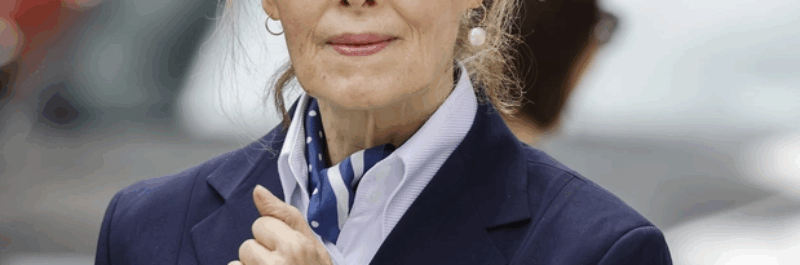
E. Jean Carroll Discusses Case
E. Jean Carroll has now admitted what many observers suspected: her courtroom presentation was not a pursuit of truth but a calculated performance.
In a stunning post-trial admission, Carroll revealed that she deliberately reconstructed her 1990s appearance — down to the hairstyle, makeup, and wardrobe — to appear “f**kable” to the jury. Her stated goal was to convince jurors that she was attractive enough back then for Donald Trump to have plausibly pursued her. Her own words? “It was enough. It was a trick.”
This is not a side note. It’s not some flippant postscript to a serious case. It cuts to the heart of what the justice system is supposed to be: impartial, evidence-based, and rooted in facts — not in theatrics, not in image management, and certainly not in retroactive seduction.
Let’s be clear: Carroll’s accusation stems from an alleged incident that supposedly took place in the mid-1990s, in a dressing room at Bergdorf Goodman. She did not go to the police. There is no physical evidence. The claim wasn’t made public until 2019 — nearly 25 years later — and conveniently timed around the release of her book. Trump, from the start, has denied ever knowing Carroll, and emphasized that she was “not my type.”
Despite this, a civil jury found Trump liable for civil battery and defamation — not rape — and hit him with a jaw-dropping $83.3 million judgment. The majority of that sum wasn’t for the alleged incident itself, but for things Trump said after the accusation was made. A process that started as a claim of personal harm ultimately became a cash-laden defamation case, driven largely by public sentiment and media spin.
And now, Carroll has confirmed what many critics warned from day one: the trial was as much a pageant as it was a proceeding. She and her team choreographed her appearance not to reflect who she is now, but to manufacture an image of who she was then — not just to jog the jury’s memory, but to manipulate their emotions. The strategy wasn’t grounded in proof. It was grounded in performance.
That should concern anyone who believes in due process — and even more so given the absence of hard evidence in the case. When a jury is swayed by optics over substance, when a plaintiff boasts about “tricking” them with a crafted aesthetic, we’re not talking about justice anymore. We’re talking about courtroom cosplay.
The media, naturally, has downplayed this admission. But they’ve already done enough damage. ABC News recently paid Trump a staggering $15 million settlement after anchor George Stephanopoulos falsely and repeatedly claimed Trump had been “found guilty of rape” — a claim no court has ever made. And while Trump faces massive penalties for his own remarks, there’s little accountability when the media spreads outright falsehoods.
The double standard is glaring. Trump is punished for denying an accusation he insists is false, while Carroll is rewarded — not just with damages, but with glowing media profiles — even as she admits to using deception to win over a jury. It’s the kind of asymmetry that corrodes public trust.