

Researchers Recover Lost Pages from New Testament Manuscript
Researchers have recovered 42 long-lost pages from one of the world’s most important early New Testament manuscripts, uncovering hidden text that had remained invisible for centuries beneath layers of rewritten parchment.
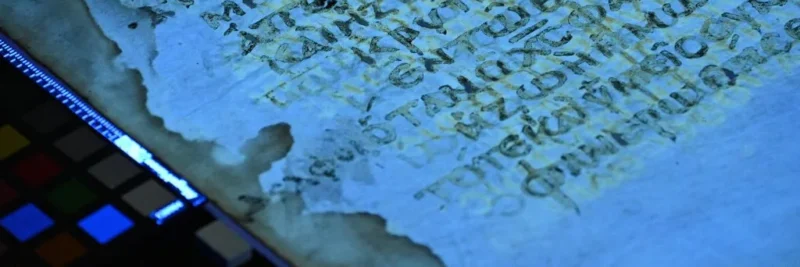
The breakthrough centers on Codex H, formally known as Codex Hierosolymitanus, an ancient biblical manuscript dating back to the sixth century. Scholars announced the discovery in an April 24 statement released by the University of Glasgow after using advanced imaging technology to reveal “ghost” text hidden beneath later writing.
Codex H is known as a palimpsest, meaning the original manuscript was partially erased, reused, and rewritten over time — a common practice in eras when parchment was extremely expensive and scarce.
Researchers first realized something unusual had occurred when they discovered portions of the manuscript had been re-inked centuries ago. That process left behind faint mirror-image traces of the original writing beneath the visible text.
Using multispectral imaging technology capable of detecting ink invisible to the naked eye, scholars successfully recovered dozens of missing pages that had effectively disappeared from history.
“The fragments show how 6th-century scribes corrected, annotated and interacted with sacred texts,” the University of Glasgow said in its announcement. “The manuscript also reveals how sacred works were reused and repurposed once they fell into disrepair.”
The recovered material does not contain previously unknown scripture. Instead, the pages are part of an ancient copy of the Letters of St. Paul.
Even so, the discovery is considered enormously important to biblical scholarship because surviving manuscripts from that period are relatively rare.
“It’s an important witness to the text of Paul’s Letters in a period where we don’t have that many manuscripts,” said Garrick Allen, the University of Glasgow professor who led the project.
The codex originally existed as a complete manuscript before being dismantled during the 13th century at the Megisti Lavra monastery on Mount Athos in Greece. Over time, the separated pages were reused in other books and scattered among libraries and collections throughout Europe.

Fragments eventually ended up at the University of Glasgow, where researchers identified the hidden pages.
Among the recovered material are ancient chapter lists that differ significantly from modern divisions of biblical texts.
The manuscript also offers a remarkably detailed glimpse into how generations of readers physically interacted with sacred writings over more than a thousand years.
According to Allen, Codex H contains more than 70 textual corrections made by scribes comparing it against other manuscript copies. It also preserves notes and annotations left behind by at least 15 different readers over the centuries.
Those markings include prayers, poems, grammatical observations, and personal notes.
“These annotations are often the only tangible evidence left that these anonymous people existed,” Allen explained.
The manuscript’s long survival is somewhat ironic because the very process that destroyed the original codex also helped preserve it.
After centuries of use, the book eventually deteriorated beyond practical repair. Rather than discard the expensive parchment, monks reused its pages as reinforcement material inside the bindings of other books.
“In a remote location like Mount Athos in a period where parchment was very expensive to produce, it makes sense that the monastery reused this manuscript,” Allen said.
That repurposing ultimately protected portions of the codex from complete destruction.
The project also highlights how modern technology is transforming biblical and historical research. Scholars increasingly use multispectral imaging, digital enhancement, and artificial intelligence tools to uncover hidden text buried beneath damaged or overwritten manuscripts.
Allen said the techniques developed during the Codex H project could now help researchers study other difficult manuscripts on a much larger scale.
“When manuscript and biblical scholars work closely with imaging specialists, data scientists, monastic communities, museums, and other local partners, we can really make progress in our understanding of these important documents,” he said.
For researchers, one of the most striking aspects of the discovery was the realization that text believed lost forever had quietly survived in plain sight for centuries.
“We have recovered these pages only due to the unintended results of a medieval conservationist,” Allen noted. “This process makes me optimistic that many ancient manuscripts still have much more to tell us."