
Wife Of Former Official Responds To Senate Vote
Anthony Fauci's long-running battle with congressional Republicans moved into considerably more serious territory Thursday, and photographs taken outside his Washington, D.C., home later that day captured a decidedly unhappy-looking former government official.
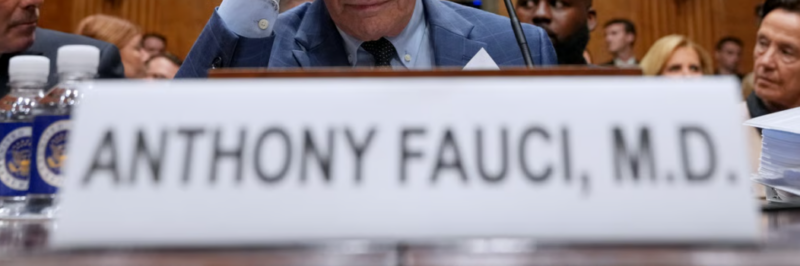
Hours earlier, the Senate Homeland Security and Governmental Affairs Committee had voted 8-5 along party lines to hold Fauci in contempt of Congress following his testimony about the federal government's handling of COVID-19.
Then came a considerably more mundane task: taking out the recycling.
Fauci was photographed outside the $2.4 million Washington home he shares with his wife, Christine Grady, wheeling a recycling bin toward the curb. The former director of the National Institute of Allergy and Infectious Diseases appeared stern-faced as he handled the chore.
If Fauci wasn't interested in entertaining the photographer, Grady made her own displeasure considerably more obvious.
After Fauci climbed into the passenger seat of their vehicle, Grady drove. As the couple departed, she raised her middle finger toward the camera. Fauci, meanwhile, was photographed staring through the window without joining his wife's one-finger commentary.
The timing made the photographs irresistible political material.

Only hours earlier, Republican senators had succeeded in advancing their case against Fauci after he invoked his Fifth Amendment right against self-incrimination 111 times during testimony the previous week.
The committee's contempt vote refers the matter to the Justice Department for potential prosecution. It does not itself convict Fauci of contempt or guarantee that criminal charges will be filed.
If a misdemeanor contempt prosecution moves forward and results in a conviction, Fauci could potentially face up to a year in prison and a $1,000 fine.

The central legal dispute concerns whether Fauci was entitled to invoke the Fifth Amendment as broadly as he did.
Republicans argue that the combination of Fauci's opening statement and the sweeping pardon issued to him by then-President Joe Biden undermined his justification for refusing to answer the committee's questions.
"The assertion of a Fifth Amendment privilege only adheres to those instances where the witness has a reasonable fear of future prosecution, and it must be tailored to any such fear," Sen. Josh Hawley of Missouri said.
Fauci's invocation of the Fifth, however, is not by itself evidence that he committed a crime. The constitutional protection exists to prevent witnesses from being compelled to provide testimony that could incriminate them, and disputes over whether the privilege properly applies can become complicated when pardons and potential exposure to different jurisdictions are involved.
Sen. Rand Paul of Kentucky has been driving the congressional investigation.
Paul, chairman of the Homeland Security Committee, subpoenaed Fauci as part of his continuing investigation into the origins of COVID-19 and the federal government's role in research conducted before the pandemic. Paul has repeatedly accused Fauci of misleading Congress and the American public and of participating in efforts to obscure information surrounding the pandemic's origins.
Fauci has disputed accusations that he engaged in a cover-up.